


On industrial automation production lines, when robots perform high-frequency object picking and transfer tasks, single-frame image output latency introduces control-loop lag, while timing mismatch between multiple cameras causes temporal misalignment in multi-view 3D reconstruction and pose estimation.
If an image arrives one frame late, the grab lags one beat; if multiple video streams fall out of sync for an instant, pose estimation loses accuracy. As embodied intelligence algorithms are deployed at scale in industrial settings, the end-to-end latency of the vision front end and the multi-channel timing synchronization precision have become key metrics that determine line takt time and operational accuracy.
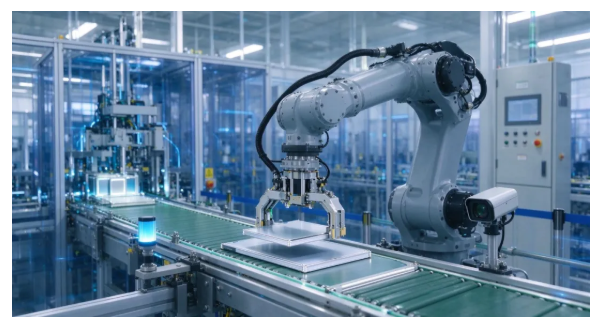
Taking a typical industrial automation scenario — production line material handling — as an example, this article describes how ALG-TECH cameras are applied in such scenarios, along with measured performance results.
ALG-TECH Cameras: Low Latency · High Synchronization · Stable Imaging
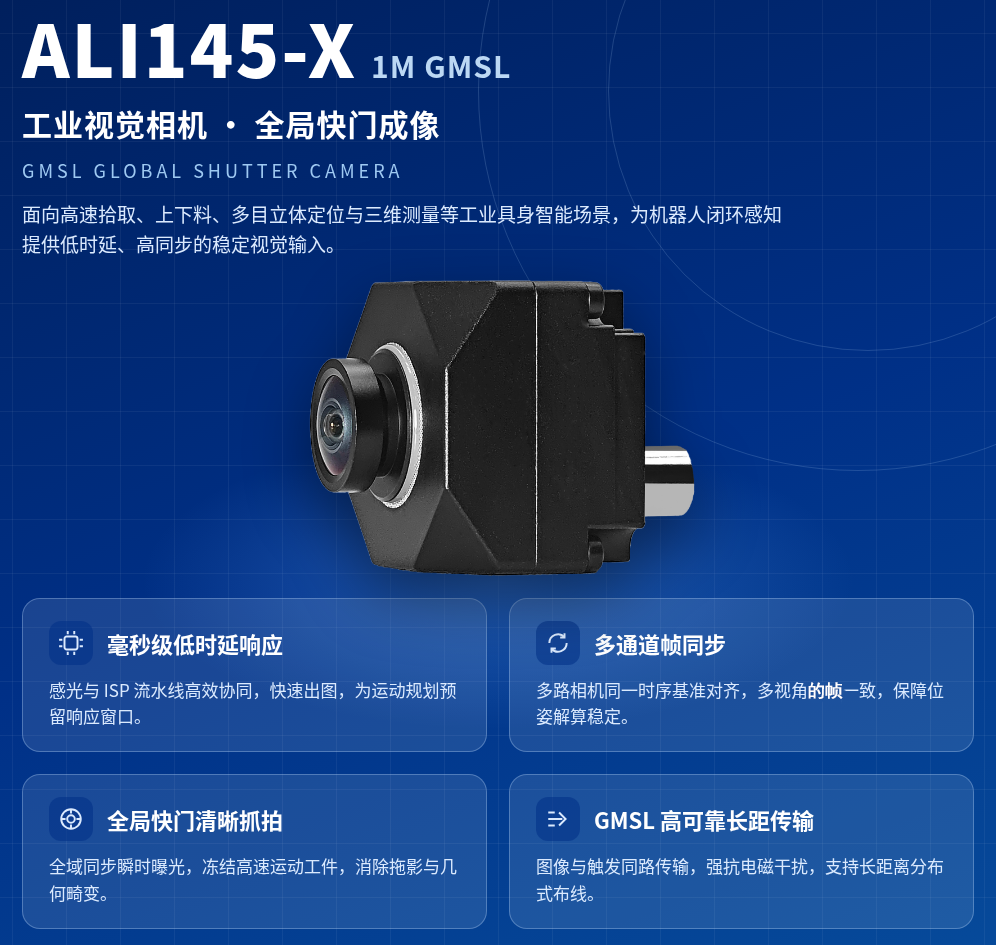
The ALG-TECH ALI145 1M GMSL industrial vision camera features global shutter imaging and targets industrial embodied intelligence scenarios such as high-speed picking, loading/unloading, multi-camera stereo positioning, and 3D measurement, providing low-latency, highly synchronized, stable visual input for closed-loop robot perception.
Millisecond-Level Low-Latency ResponseExposure and the ISP pipeline work together efficiently for rapid image output, leaving ample response time for motion planning.
Multi-Channel Frame SynchronizationMultiple camera streams are triggered and aligned on the same timing reference, keeping frames consistent across viewing angles and building a stable temporal foundation for 3D reconstruction and pose estimation.
Global Shutter for Sharp SnapshotsFully synchronized instantaneous exposure freezes fast-moving workpieces, eliminating motion blur and geometric distortion.
GMSL: Highly Reliable Long-Distance TransmissionImage and trigger signals travel over the same link, with strong resistance to electromagnetic interference and support for long-distance distributed wiring.
01 Scenario Challenges: Extreme Demands on the Vision Link at High Takt Rates
High-speed picking and loading/unloading are typical application paradigms of closed-loop perception in industrial embodied intelligence. Based on target poses output by the vision system, the robot controller completes motion planning and servo control.
End-to-end latency: The servo control cycle on production lines is on the order of milliseconds, and the front-end perception link latency needs to be below ~15 ms. Cumulative delays across photosensitive readout, ISP processing, serial transmission, deserializer buffering, host memory copy, and other stages directly compress the time window available for robot motion planning and servo response.
Multi-channel frame-level synchronization: Multi-camera stereo positioning relies on multi-view observations taken at the same instant. Timing deviations in frame-start (SOF) signals across multiple image streams introduce 3D reconstruction errors, causing pose estimation drift and pick failures.
Strong electromagnetic compatibility and long-distance transmission: Robotic-arm servo drives and variable-frequency drives create a complex electromagnetic noise environment; cameras and host machines are often separated by considerable wiring distances, requiring serial links with high interference immunity to ensure reliable transmission of image and trigger signals.
02 Latency Testing: Stage-by-Stage Breakdown of the Full Link
On a standardized industrial host platform, we tested the full chain — "trigger → client image retrieval" — stage by stage, using dual verification via oscilloscope measurement and software timestamping, and compared it with other camera solutions on the market under identical conditions:
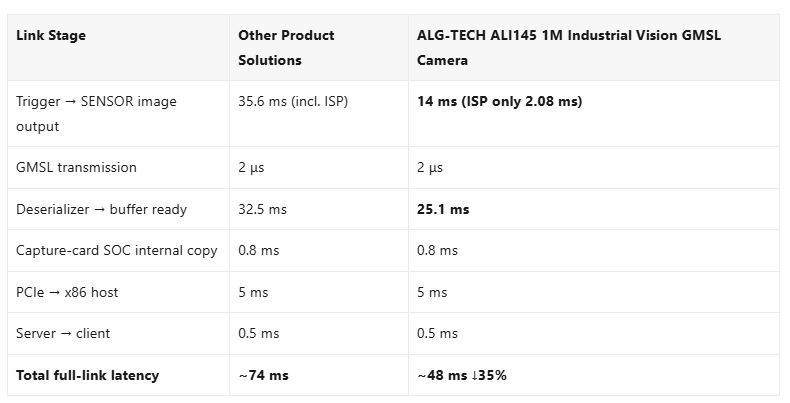
The data shows that the ALG-TECH ALI145 1M industrial vision GMSL camera's link advantages come mainly from two core designs of the camera itself: trigger-to-image output in only 14 ms (vs. 35.6 ms for other product solutions) and ISP processing taking only 2.08 ms, combined with a leading margin of 7 ms+ in the deserialization output stage — compressing the entire vision link by roughly 26 ms compared with mainstream solutions.
In addition, this camera adopts a global shutter imaging architecture, which performs instantaneous exposure freezing of moving targets, eliminating motion distortion and image smear caused by rolling shutters, making it well suited to pose observation of fast-moving targets.
03 Synchronization Performance: Frame-Level Aligned Multi-Channel Acquisition
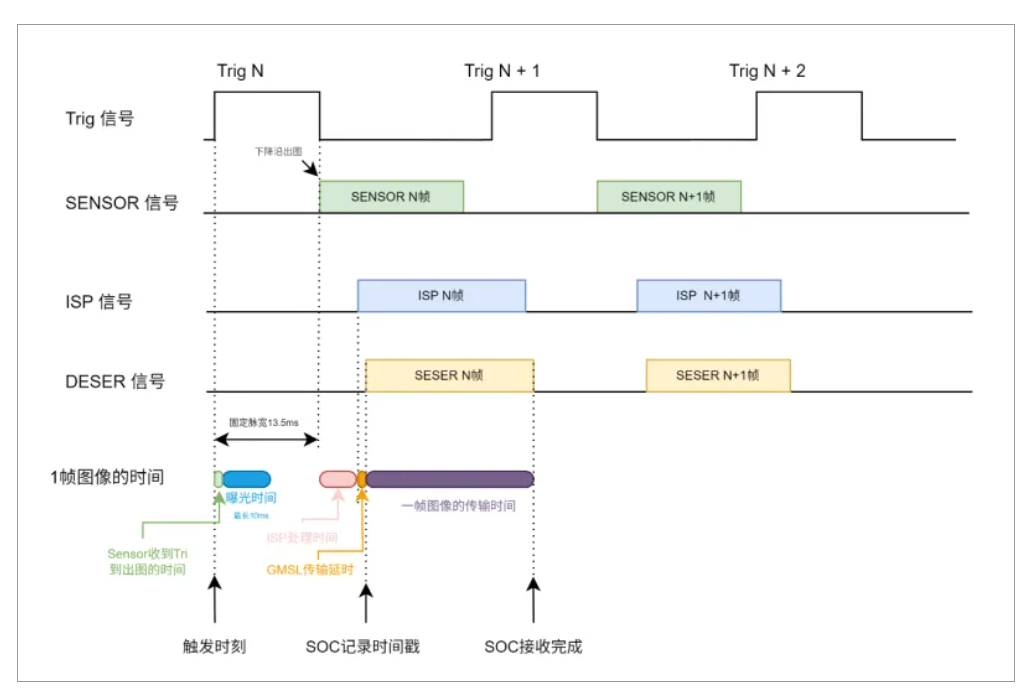
For three-camera systems and even 16-camera arrays, synchronization is just as important as low latency. Testing verified the synchronization performance of ALG-TECH cameras at both the hardware and system levels:
Hardware-level synchronization: The maximum frame-start (SOF) deviation across 4 deserializer channels is no more than 10 μs (mainstream solutions measured at 42.8 μs);
System-level synchronization: With all 16 channels running at full load, statistics were drawn from 1,400 sets of same-frame data — 95% of timestamp differences fell stably within the 15–25 μs range, with consistent results across multiple rounds of retesting. Comparison solutions mostly ranged between 30–40 μs, but exhibited occasional single-channel desynchronization events with offsets of about 400 μs.
Meanwhile, a "running-light photographing" method was used to verify content-level synchronization across the 16 channels: in the same frame, the running lights captured by every channel were frozen at the same coordinate position. This means that no matter which combination of viewing angles downstream algorithms fuse, the temporal reference for pose estimation remains strictly aligned — frame-level stable synchronization is the invisible foundation on which reliable multi-view perception systems run.
04 Scenario Value Advantages
Low latency paired with high frame-rate outputLeaves ample time for algorithm computation, motion planning, and servo control, supports faster line cycle rates, and adapts to work conditions with more dynamic workpiece motion.
Stable imagingGlobal shutter plus excellent high-dynamic-range imaging eliminates motion distortion and keeps imaging stable under alternating light and dark conditions. Backed by the high-frame-rate timing link, it extends to more embodied intelligence scenarios with demanding timing and high dynamics, such as high-speed sorting, 3D measurement, and mobile robots.
Lower on-site deployment costsGMSL long-distance transmission and strong EMC immunity suit the distributed multi-camera wiring of robotic arms, keep signals stable during high-dynamics continuous acquisition, and simplify on-site commissioning and later maintenance.
Stable productionStable, controllable multi-channel timing alignment maintains temporal consistency even under high-dynamics, high-frame-rate continuous acquisition, reducing random pick failures and workpiece collisions, and cutting material waste and unplanned downtime.
From industrial automation production lines to the broader embodied intelligence frontier, ALG-TECH will continue to build on solid perception-link capabilities, helping robots see faster, more stably, and more accurately in the real industrial world.