


Machine vision is the core module for perceiving the external environment. However, during project development, R&D teams often face challenges such as difficult hardware selection, poor compatibility with host platforms, and scattered development documentation — all of which extend the project validation cycle.
ALG-TECH has built a complete robot vision ecosystem product matrix, covering MIPI and GMSL interface cameras as well as vision development kits, helping developers quickly complete robot vision prototype validation.

Many embedded projects use different host platform solutions, and whether a vision module is compatible with the existing computing platform directly determines project efficiency. ALG-TECH vision modules are deeply adapted to mainstream embedded platforms on the market, covering popular development boards from NVIDIA, Rockchip, Raspberry Pi, D-Robotics (地瓜机器人), and Espressif. [图

Dual Technology Product Lines, Covering All Levels of Needs
MIPI General-Purpose Vision Cameras | Lightweight Embedded Perception Solutions
AMP121-C, AMP360-C

1. Built-in edge ISP engine: Hardware-level auto exposure, white balance, HDR synthesis, and noise reduction, offloading the host's computing overhead.
2. 120dB WDR (Wide Dynamic Range) imaging, preserving scene details under complex lighting conditions.
3. Ultra-wide field-of-view options: FOV covering 100°–200°, suitable for navigation, obstacle avoidance, mapping, and environmental perception.
4. 2-Lane MIPI CSI-2 interface + integrated FPC link, simplifying hardware structure design.
GMSL Industrial / Automotive Cameras | High-Reliability High-Speed Perception Solutions
ALI121-Y, ALI360-YH

1. GMSL2 high-speed differential coaxial transmission: Long-distance, strong anti-interference capability, suitable for automotive and industrial wiring.
2. IP67 protection rating, stable operation across a wide temperature range of ‑20℃ to +65℃, resistant to dust, rain, and vibration.
3. Hardware external trigger synchronization mechanism: Enables precise timestamp alignment across multiple cameras and sensors, supporting multimodal perception fusion.
4. HDR imaging + Anti-Flicker LED suppression: Ensures stable output of perception algorithms under complex light sources.
5. Up to 30fps high frame rate output, meeting real-time perception in dynamic scenarios.
Ecosystem Support: GMSL Adapter Hardware
In industrial and automotive scenarios, GMSL cameras output high-speed differential serial signals, while mainstream embedded hosts such as RDK X5, Jetson, and Rockchip natively provide only MIPI-CSI interfaces. Without deserializer adapter hardware, developers would have to complete SerDes circuit design, timing debugging, and driver adaptation on their own — a massive hardware development workload and a major barrier to deploying multi-camera solutions.
ALG-TECH has simultaneously released different versions of adapter hardware for Jetson, D-Robotics, and Rockchip RK series platforms, enabling cameras to be rapidly deployed on various carriers such as inspection unmanned vehicles and industrial AGVs.

Taking the D-Robotics RDK X5 platform as an example, with the dedicated RDK X5 adapter board, multiple GMSL and MIPI series camera modules can be connected simultaneously. The solution supports plug-and-play adaptation and multi-camera synchronized acquisition, greatly simplifying multi-camera hardware wiring and low-level debugging — ideal for rapid prototyping of robot vision solutions.

Technical Support
Beyond hardware solutions, ALG-TECH has built a complete technical support system — from hardware schematics to software development documentation, everything is provided — lowering the entry barrier and reducing trial-and-error costs.
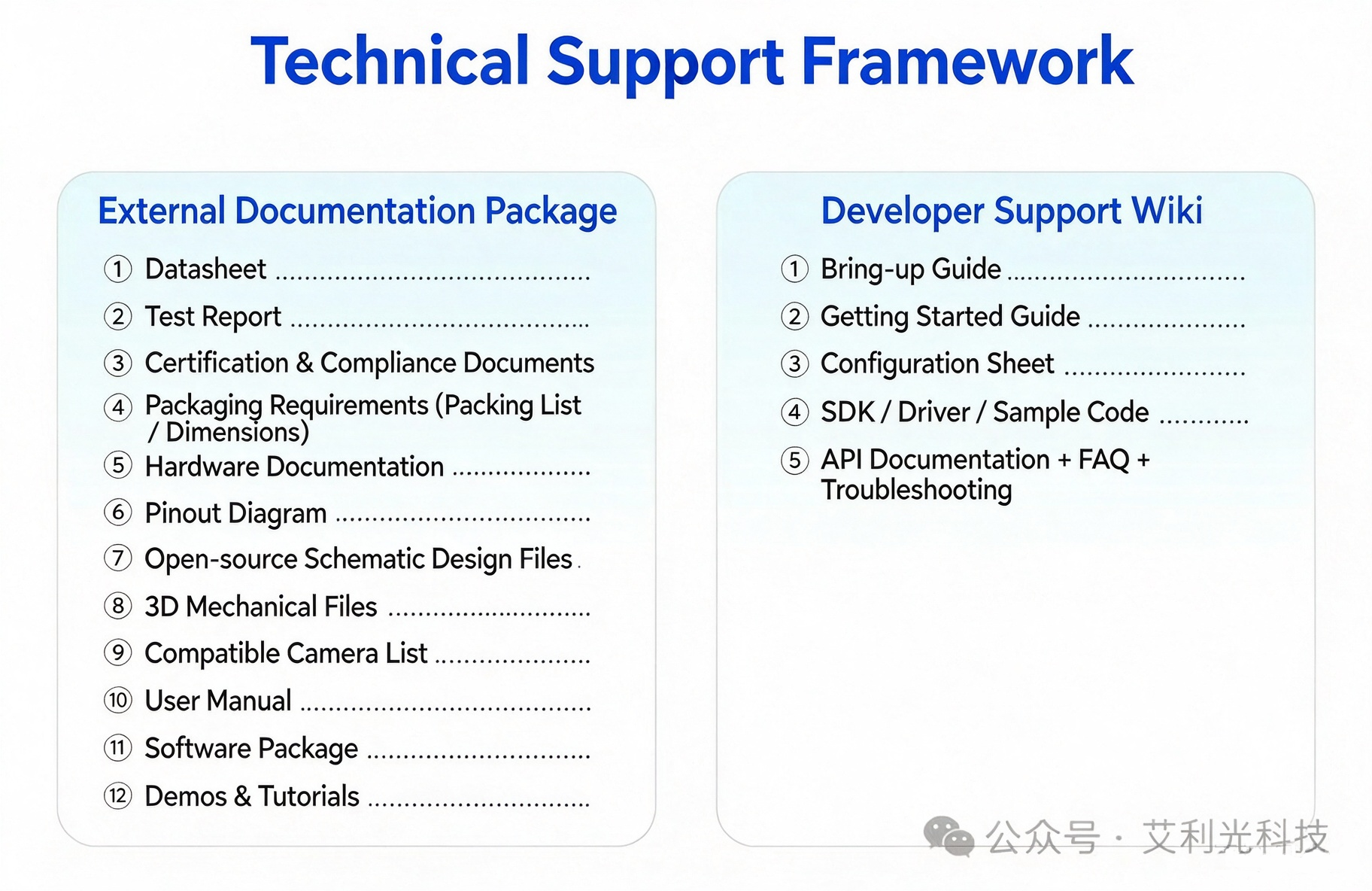
From rapid prototype validation to production-grade hardware delivery, ALG-TECH's MIPI & GMSL vision ecosystem provides full-stack support — imaging modules, adapter hardware, driver SDKs, and application examples — building a stable, high-performance "eye" of visual perception for all kinds of intelligent carriers.